

Executive Overview
Our insights are not speculative trend forecasts or marketing summaries. They are grounded in real implementation data, production incident reviews, and regulatory engagement across the UAE, Saudi Arabia, and Oman. We publish technical perspectives to help bank boards, CIOs, and digital leaders cut through technology hype and make prudent capital allocation decisions.Selected Research Reports & Executive Briefings
Briefing 01: The GCC Mobile Banking CX Index (2026 Edition)
Topic: A Comparative Audit of 12 Regional Banking Applications Across the UAE, KSA, and Oman. Executive Summary: Over a 90-day testing cycle, our research team benchmarked 12 prominent Gulf retail banking applications against 48 usability, performance, and security metrics. The findings show a widening divergence between agile digital banks (such as Wio, Liv, and D360) and legacy incumbent apps.- Onboarding Speed: Challenger apps averaged 2 minutes and 45 seconds for full account creation using digital ID (UAE PASS / Nafath), while incumbent retail banks averaged 9 minutes and required an average of 4.2x more manual input fields.
- Biometric Failure Recovery: 67% of legacy apps lacked a clean fallback mechanism when biometric hardware failed, forcing customers to undergo painful password reset flows that generated high call center volume.
- Instant Payment Adoption: Institutions that integrated national instant rails (Aani and SARIE) prominently on their home dashboard recorded a 310% increase in 30-day active user retention compared to those that hid instant rails behind legacy transfer menus.
Briefing 02: Pragmatic AI Governance for Middle Eastern Finance
Topic: Navigating CBUAE Circular 24/2023 and SAMA Ethical AI Frameworks in Production. Executive Summary: Gulf banks are under intense board pressure to roll out generative AI, but general-purpose cloud LLMs present unacceptable compliance risks around data sovereignty and non-deterministic answers. This paper outlines an audited blueprint for deploying private, governed AI within regulated banking environments.- The Sovereign Boundary: How to deploy open-weight foundation models (e.g. Llama-3-Fin, Falcon) inside on-premise infrastructure or local sovereign cloud zones (Moro Hub, Injazat) to satisfy strict data residency laws.
- RAG Architecture with Deterministic Guardrails: Utilizing Retrieval-Augmented Generation tied strictly to verified bank policy documents and customer ledgers, eliminating hallucinations in customer support and automated loan pre-qualification.
- Audit-Ready Logging: Structuring comprehensive inference telemetry, token inputs, and approval chains to satisfy Central Bank supervisory reviews.
Briefing 03: Core Modernization Without Stranding Operations
Topic: Applying the Strangler Fig Pattern to Monolithic Temenos, Finacle, and Mainframe Cores. Executive Summary: High-profile core replacement failures have made bank boards cautious about big-bang migrations. This technical paper provides an architectural guide for modernizing core capabilities incrementally while keeping production ledgers online.- The Dual-Layer Architecture: Placing an asynchronous Kafka event mesh and Redis cluster between digital channels and core processing engines.
- Handling Batch Windows: Techniques for providing mobile customers with continuous, real-time balance views even while the core ledger undergoes overnight batch reconciliation.
- Progressive Migration Milestones: How to isolate and migrate single business domains (e.g. card controls, instant domestic transfers, foreign currency wallets) one by one without risking operational disruption.
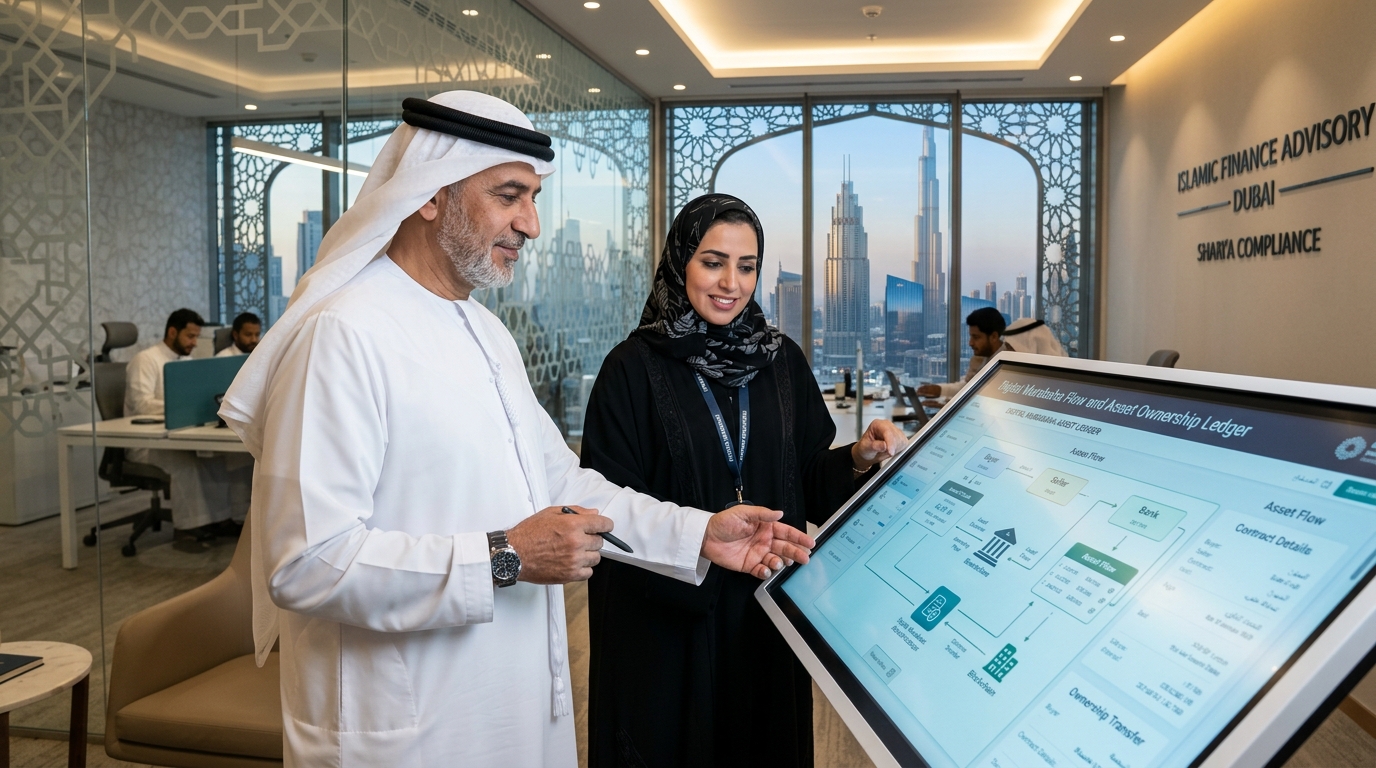
Briefing 04: Digitizing Sharia Contracts: Technical Patterns for AAOIFI Compliance
Topic: Engineering Deterministic State Machines for Murabaha, Ijara, and Wakala Products. Executive Summary: As Islamic banks shift from branch-based paperwork to mobile app onboarding, ensuring that digital workflows satisfy strict Sharia principles is paramount. This white paper bridges the gap between Islamic legal requirements and software engineering.- Chronological Validity in Murabaha: Ensuring that the software architecture strictly separates the bank’s commodity purchase order from the customer’s purchase undertaking, preventing invalid forward sales.
- Immutable Audit Trails: Using cryptographically signed time-stamps and distributed ledger logging to provide Sharia supervisory boards with verifiable proof of asset ownership transfer.
- Digital Contract Visualization: Designing interface ergonomics that present Sharia profit rates, agency appointments (Wakala), and insurance allocations with total transparency to the consumer.
Quarterly Advisory Briefings for Financial Institutions
Fintechify provides tailored private briefings for bank executive committees, technology risk boards, and product strategy teams. To request a private executive session or download full technical white papers, reach out through our Advisory Consultation Portal.Related Case Studies & Proven Work
Sharjah Islamic Bank (SIB)
Comprehensive digital platform review and benchmarking across four flagship mobile applications, uncovering friction points and delivering an actionable modernization roadmap.
Explore Engagement
Al Rajhi Bank Malaysia · Rize Digital Bank
Next-generation digital bank platform delivering 15-minute personal financing, Ready CashLine credit, digital term deposits, and 99.98% crash-free stability.
Explore Engagement
GCC NeoBank UX Benchmark Report
Comprehensive usability audit evaluating a 34-step onboarding journey, 13 maturity dimensions, wealth marketplace, and conversational AI.
Explore Engagement